Presidential Vacation

College Station, Austin & Houston

July 28 – July 31, 2022

Who Joined

Dan
Dave
Jason
Ryan

Itinerary

Day 1

College Station — Bush Presidential Library

Thursday, July 28
  • Fly into Houston (George Bush Intercontinental and Hobby airports)
  • Travel to College Station
  • George H. W. Bush Presidential Library and Museum
  • Travel to Austin
Day 2

Austin — LBJ Historical Sites

Friday, July 29
  • LBJ National Historical Park — LBJ Ranch, Stonewall
  • Lyndon B. Johnson Presidential Library and Museum, Austin
Day 3

Austin → Houston — Capitol, Space Center & Astros

Saturday, July 30
  • Texas State Capitol Building, Austin
  • Travel to Houston
  • Space Center Houston
  • Seattle Mariners vs. Houston Astros at Minute Maid Park
Day 4

Departure

Sunday, July 31
  • Depart for home

Historical Sites

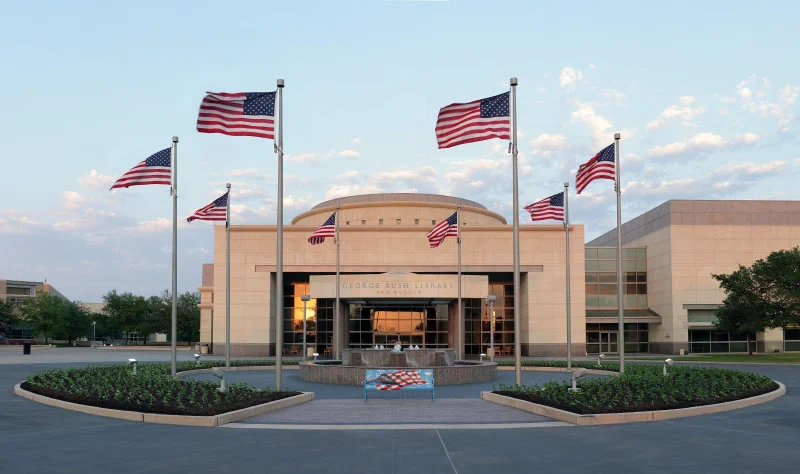
George H. W. Bush Presidential Library and Museum

George H. W. Bush Presidential Library and Museum

The presidential library and museum dedicated to the 41st president, located on the campus of Texas A&M University — covering Bush's naval service in World War II, his career in diplomacy and intelligence, and his presidency from 1989 to 1993.

Learn more

George H. W. Bush served longer in public life before reaching the presidency than almost any of his predecessors — as a Navy torpedo bomber pilot in World War II, a Texas congressman, ambassador to the United Nations, envoy to China, CIA director, and two-term vice president under Ronald Reagan. The museum traces this arc through artifacts, film, and immersive galleries, including a recreation of the Oval Office and exhibits on the fall of the Berlin Wall, the Gulf War coalition, and the Americans with Disabilities Act.

The library building, designed by Hartman-Cox Architects and opened in 1997, sits on ninety acres of Texas A&M’s campus. Bush chose College Station in part because of his close relationship with the university, and he and Barbara Bush are buried on the grounds near a reflecting pool. Bush’s presidential papers and more than forty million historical documents are held in the adjacent research library and made available to scholars.
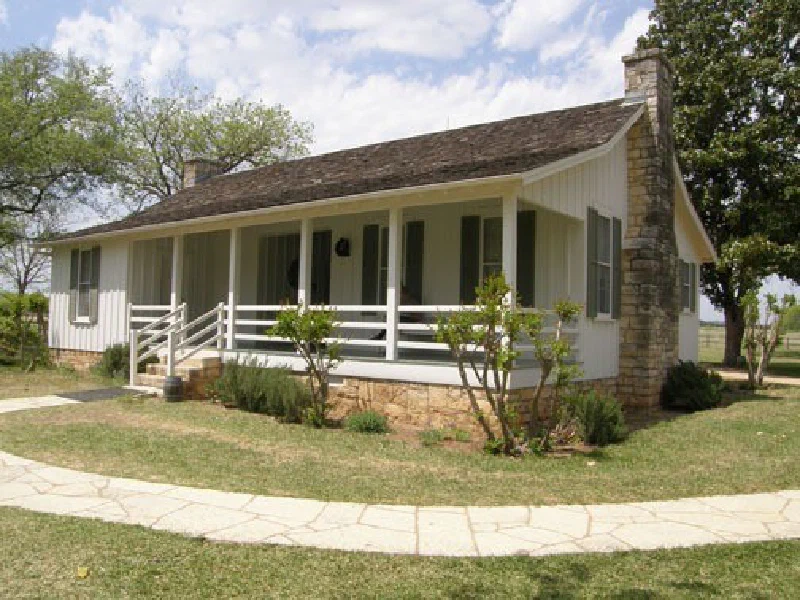
Lyndon B. Johnson National Historical Park — LBJ Ranch

Lyndon B. Johnson National Historical Park — LBJ Ranch

A National Park Service site preserving the Texas birthplace, working ranch, and final resting place of the 36th president — offering a rare look at the Hill Country landscape that shaped Lyndon Baines Johnson's character and his vision of rural America.

Learn more

The LBJ Ranch, which Johnson called his “Texas White House,” is located along the Pedernales River in the Hill Country outside Stonewall. Johnson was born in a small farmhouse nearby in 1908, and the reconstructed birthplace — situated next to the family cemetery where he is buried — remains one of the park’s most visited points. Johnson returned to the ranch repeatedly throughout his presidency, hosting foreign leaders, conducting negotiations, and recuperating from the relentless pace of Washington.

The National Park Service acquired the working ranch after Lady Bird Johnson’s death in 2007 and operates it in partnership with the LBJ Foundation. Bus tours from the visitor center take guests past the airstrip where Air Force One landed, the cattle pens, and the reconstructed one-room schoolhouse where Johnson received his early education. The property conveys the deep connection between Johnson’s agrarian roots and the sweeping ambitions of his Great Society domestic agenda.

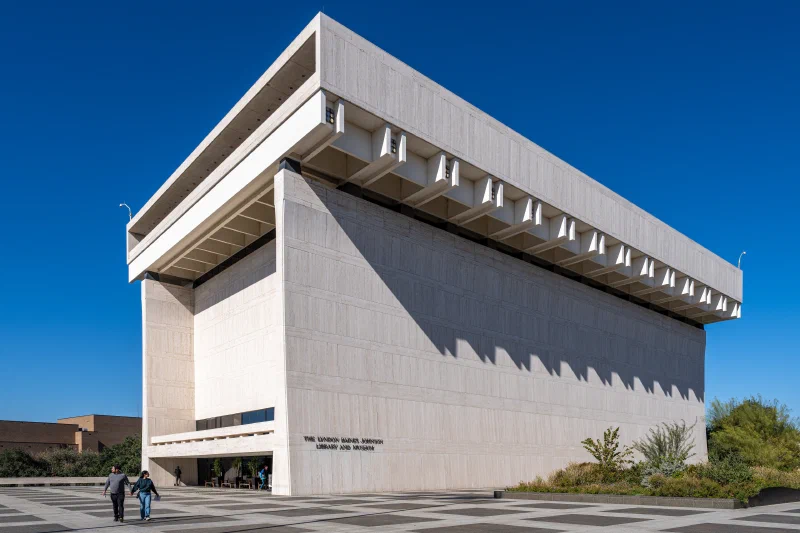
Lyndon B. Johnson Presidential Library and Museum

Lyndon B. Johnson Presidential Library and Museum

The presidential library on the University of Texas at Austin campus, holding forty-five million pages of historical documents and chronicling Johnson's presidency through exhibits on civil rights, Vietnam, the Great Society, and the social transformation of 1960s America.

Learn more

Opened in 1971 while Johnson was still alive, the LBJ Library was among the first presidential libraries to emphasize the turbulent politics of its subject’s era rather than simply celebrating the president’s legacy. Its eight-story tower on the University of Texas campus houses an archive used by researchers worldwide, while the public museum floors offer exhibits on the Civil Rights Act of 1964, the Voting Rights Act of 1965, the escalation of the Vietnam War, and the social upheaval that defined Johnson’s single elected term.

A full-scale, seven-eighths replica of the Oval Office as it appeared during Johnson’s presidency anchors the museum’s upper floor. The library’s holdings include recordings of Johnson’s often candid and unfiltered telephone conversations — a collection that has reshaped historians’ understanding of presidential decision-making in the 1960s. Johnson himself attended the dedication ceremony in May 1971 and is said to have wept during the remarks about his legacy.

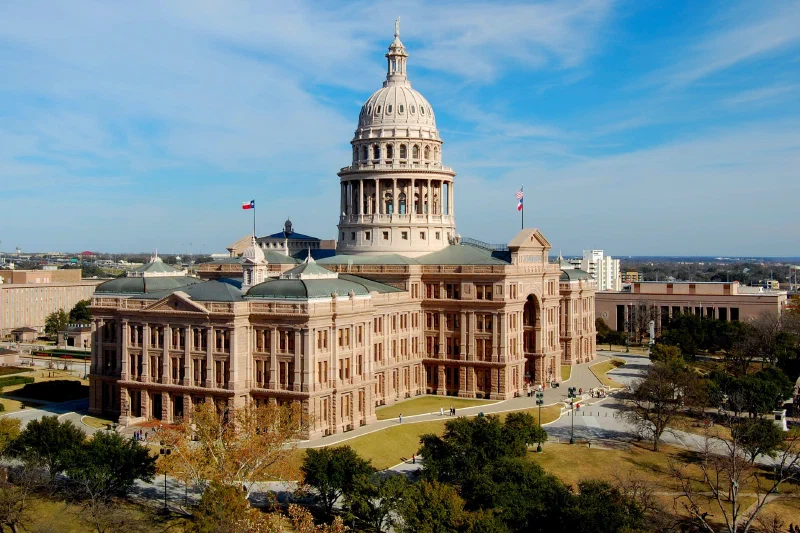
Texas State Capitol

Texas State Capitol

The seat of Texas state government since 1888, a Renaissance Revival limestone landmark that stands seven feet taller than the U.S. Capitol and dominates the Austin skyline from the northern end of Congress Avenue.

Learn more

Completed in 1888 after a six-year construction project, the Texas State Capitol was built from Sunset Red granite quarried near Marble Falls and was funded through an exchange of public land rather than cash — the state traded three million acres of Panhandle rangeland to a Chicago syndicate in exchange for the building’s construction. The result was the largest state capitol building in the country by total area, and its dome rises to 302 feet, surpassing the dome of the U.S. Capitol by seven feet — a distinction Texans have never tired of noting.

The building houses the Texas Senate, the Texas House of Representatives, the offices of the governor and lieutenant governor, and the Supreme Court of Texas. The rotunda’s interior features a series of portraits of every Republic of Texas president and Texas state governor arranged around a mosaic terrazzo floor inlaid with the seals of the six nations that have governed Texas. The Capitol was added to the National Register of Historic Places in 1970 and underwent a comprehensive restoration in the 1990s.

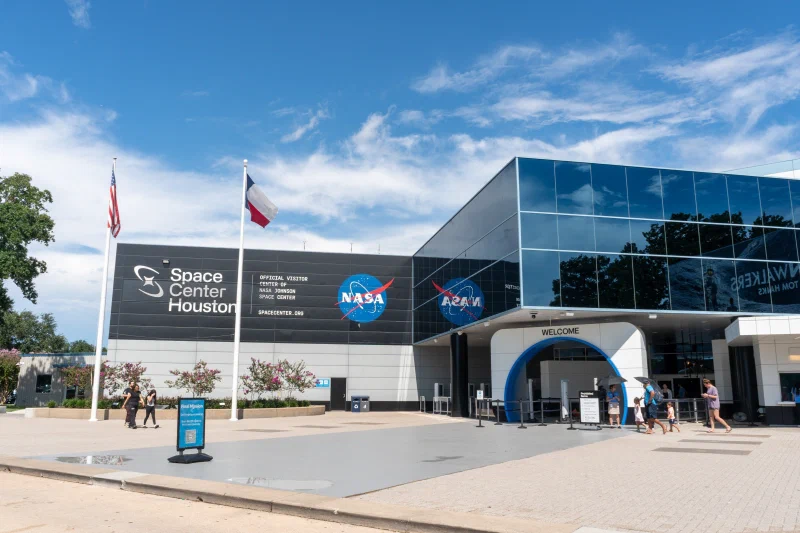
Space Center Houston

Space Center Houston

The official visitor center of NASA's Johnson Space Center, where mission controllers have guided every crewed American spaceflight since Gemini — home to a Saturn V rocket, the original Mission Control, and artifacts from the Apollo, Shuttle, and ISS programs.

Learn more

Johnson Space Center has been the hub of American human spaceflight operations since 1961, managing missions from the Gemini program through the Space Shuttle era and the ongoing International Space Station operations. The Saturn V on display — one of only three surviving flight-ready examples — is 363 feet long and remains the most powerful rocket ever flown, capable of generating 7.6 million pounds of thrust. It carried twelve astronauts to the lunar surface between 1969 and 1972.

Tram tours from the visitor center bring guests onto the JSC campus itself, including the historic Mission Control facility where Gene Kranz and his flight controllers managed the Apollo 13 emergency in April 1970. The room has been meticulously restored to its Apollo-era configuration, down to the ashtrays on the consoles. Additional exhibits cover the Space Shuttle program, International Space Station hardware, and the future of human exploration beyond low Earth orbit.

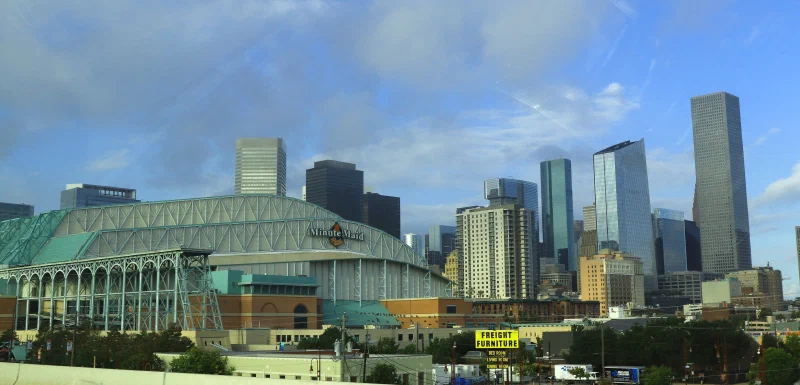
Minute Maid Park

Minute Maid Park

Home of the Houston Astros since 2000, a retractable-roof ballpark in downtown Houston featuring a vintage locomotive above left field and a classic urban design that brought Major League Baseball back to the heart of the city.

Learn more

Minute Maid Park opened in April 2000 as Enron Field and was the centerpiece of Houston’s downtown revitalization effort, replacing the suburban Astrodome as the Astros’ home. The ballpark was built into the shell of Houston’s historic Union Station, preserving the 1911 brick façade and incorporating the station’s clock tower into the left-field entrance. A vintage replica locomotive and a 50,000-gallon water tank mounted above the left-field wall travel along a 800-foot track whenever an Astro hits a home run or the team wins.

The 2022 trip’s Mariners-Astros matchup came with extra significance — Houston was on its way to a World Series championship that fall, while Seattle was in the midst of ending a 21-year playoff drought, the longest active streak in North American professional sports. The park’s retractable roof, essential for Houston’s notoriously humid July evenings, kept conditions comfortable throughout the game.

The Game

Seattle Mariners @ Houston Astros

Saturday, July 30, 2022
SEA • AL
Seattle Mariners
3
vs
HOU • AL
Houston Astros
7
🏆 Minute Maid Park, Houston, TX 👥 34,521 fans
Pitching
Win Framber Valdez (HOU) 7 IP, 5 H, 2 ER, 9 K
Loss Robbie Ray (SEA) 4.1 IP, 7 H, 5 ER, 5 K
Home Runs
  • Yordan Alvarez (HOU) — Inning 3 · 438 ft · off Robbie Ray
  • Kyle Tucker (HOU) — Inning 5 · 392 ft · off Robbie Ray

Framber Valdez was dominant through seven innings, striking out nine Seattle batters as the Astros cruised to a 7-3 win at Minute Maid Park. Yordan Alvarez put Houston on the board early with a towering 438-foot blast in the third inning, and Kyle Tucker added a two-run shot in the fifth to break the game open. The Astros were rolling toward a World Series title while the Mariners were building a team that would end a 21-year playoff drought later that fall.